
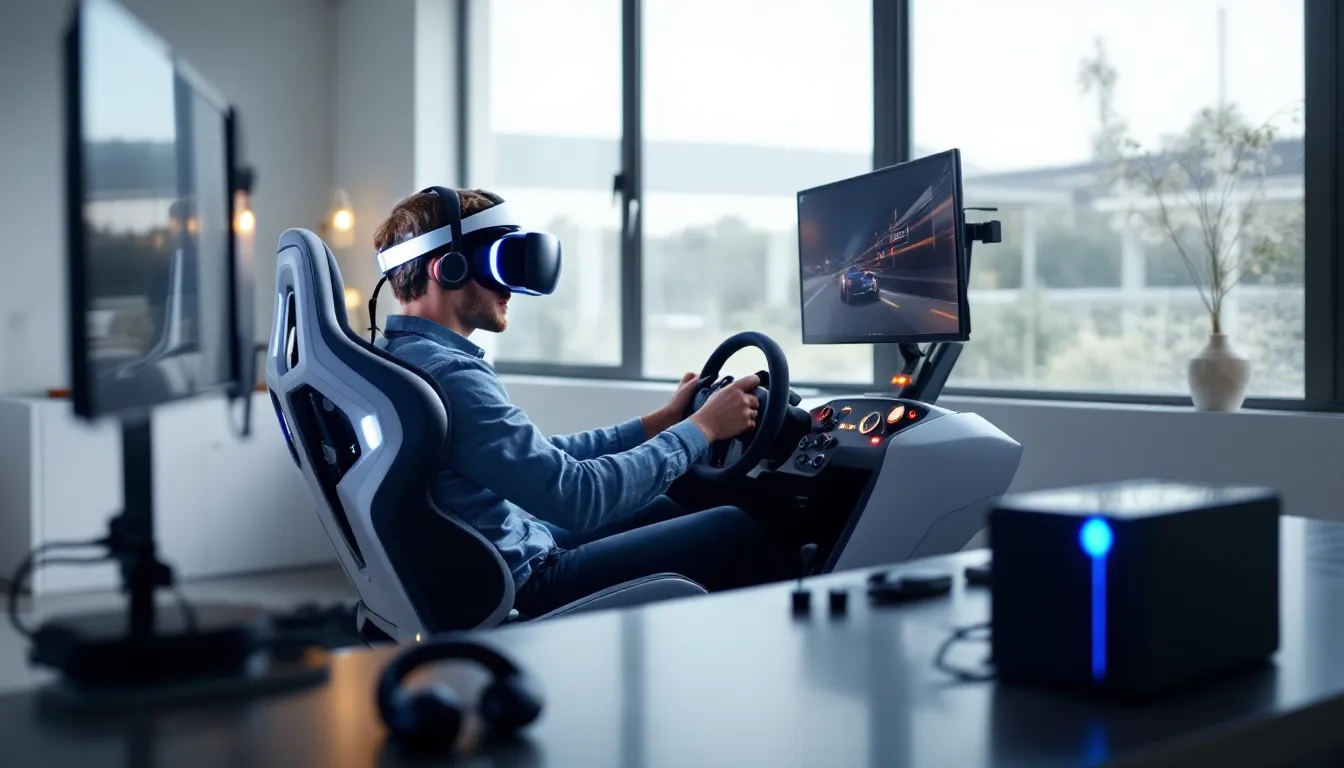

Virtual reality has transformed how players experience racing games, and Sony’s PSVR2 headset represents the current peak of that evolution. With eye-tracking, headset haptics, and 4K HDR visuals at 90Hz-120Hz, the PSVR2 delivers immersion that flat screens simply can’t match. Whether sliding through corners in a hypercar or feeling the cockpit rumble through the headset itself, VR racing creates an entirely different relationship with the track.
For racing enthusiasts considering the jump to VR or current PSVR2 owners hunting for their next adrenaline rush, the platform’s library has matured significantly since launch. This guide breaks down the best PSVR2 racing games available in 2026, what makes VR racing fundamentally different from traditional gameplay, and how to build a setup that maximizes every lap.
Key Takeaways
- PSVR2 racing games deliver immersive experiences through eye-tracking, headset haptics, and 4K HDR visuals that fundamentally transform how players engage with racing compared to flat screens.
- Gran Turismo 7 remains the flagship PSVR2 racing title with full VR support across all modes, 400+ vehicles with modeled cockpits, and ongoing updates that enhance the racing experience.
- A complete PSVR2 racing setup requires investment in a compatible racing wheel (Logitech G29, Thrustmaster T248, or Fanatec GT DD Pro) and a stable cockpit rig to maximize immersion and performance.
- VR racing demands acclimation to prevent motion sickness; starting with slower cars, limiting session length to 15-20 minutes, and using comfort settings help players adapt faster.
- PSVR2 racing currently lacks dedicated arcade racers and rally/off-road titles, but upcoming support from sim franchises and indie developers could expand the platform’s competitive library.
- The future of PSVR2 racing depends on hybrid VR/flat development becoming standard and Sony maintaining long-term platform commitment to justify developer investment.
Why PSVR2 Is a Game-Changer for Racing Enthusiasts
Enhanced Visuals and Immersion
The PSVR2’s dual OLED panels deliver 2000×2040 resolution per eye, providing crisp track details that earlier VR headsets struggled with. Combined with foveated rendering, which uses eye-tracking to render only what the player is looking at in full detail, games maintain visual fidelity without tanking frame rates. This matters enormously when apexing a corner at 150 mph: peripheral blur feels natural rather than distracting.
Headset haptics add another sensory layer. The PSVR2 vibrates subtly when engines rev or tires lose grip, creating feedback that complements what players feel through a wheel or controller. It’s a small detail that compounds immersion, especially during intense moments like hitting a rumble strip or surviving contact with another car.
Foveated rendering also reduces the performance overhead that plagued earlier VR racing attempts. Games can push higher graphical settings because the PS5 isn’t rendering the entire field of view at maximum detail. The result is smoother frame pacing and less motion blur during high-speed sequences.
Precision Controls and Haptic Feedback
The DualSense controller integration brings adaptive triggers and haptic feedback directly into VR racing. Brake pressure, throttle modulation, and ABS kickback translate into finger-level feedback. Players feel resistance increase as brakes heat up or tires lose traction, a tactile language that helps them drive more intuitively.
For those using a racing wheel, PSVR2 compatibility with wheels like the Logitech G29, G923, Thrustmaster T248, and Fanatec GT DD Pro means force feedback pairs with VR’s spatial awareness. Looking into an apex while feeling the wheel fight back through understeer creates muscle memory faster than any flat-screen session could.
The combination of head-tracked perspectives and physical controls closes the gap between sim and reality. Players instinctively check mirrors by glancing left or right, track corner entry points with their eyes, and feel steering input through their hands, all simultaneously. This multi-sensory loop is why many competitive sim racers have adopted VR as their primary platform.
The Best PSVR2 Racing Games Available Now
Gran Turismo 7 VR: The Definitive Sim Racing Experience
Gran Turismo 7 remains the flagship PSVR2 racing title as of early 2026, and for good reason. Polyphony Digital implemented full VR support across all gameplay modes, career, Sport Mode, Time Trials, and online multiplayer. Every car in the 400+ vehicle roster is playable in VR with fully modeled cockpits, and the attention to interior detail is staggering.
The headset’s eye-tracking enables natural mirror checks and apex spotting. Players report shaving seconds off lap times simply by being able to look through corners naturally rather than relying on fixed camera angles. Weather effects like rain droplets on windshields or fog rolling across tracks become legitimately challenging rather than cosmetic.
Performance targets 90fps in reprojection mode or native 60fps with enhanced visuals, and the game maintains stability even during 16-car grids. The haptic feedback through the headset syncs with road surfaces, cobblestones at Goodwood, kerbs at Laguna Seca, bumps at the Nordschleife, adding texture that flat-screen players miss entirely.
Gran Turismo 7’s VR mode also benefits from ongoing support. Update 1.47 in December 2025 added PSVR2-specific HUD customization, letting players remove UI elements for a cleaner cockpit view or add telemetry overlays for data-driven tuning. For sim racing purists, it’s the most complete package on PSVR2.
Kayak VR: Mirage and Other Alternative Racing Experiences
While Kayak VR: Mirage isn’t a traditional racing game, it offers competitive time-attack gameplay across stunning aquatic environments. Players paddle through checkpoints in locations like Norway’s fjords and Antarctica’s icebergs, and the PSVR2’s visuals shine in these wide-open spaces. The game supports online leaderboards and ghost racing, giving it legitimate competitive depth.
For those seeking arcade racing thrills, the library remains thinner than sim options. Firewall Ultra includes vehicle sequences but isn’t a dedicated racer. Horizon Call of the Mountain features brief chariot and mount-racing segments, but they’re minor gameplay components rather than core experiences.
The absence of dedicated arcade racers like a VR-enabled WipEout or MotorStorm remains one of PSVR2’s gaps. Players hoping for over-the-top, boost-filled action in VR are currently out of luck unless they boot up No Man’s Sky, which offers spaceship racing through procedural rings, admittedly niche, but surprisingly entertaining in VR.
Upcoming and Recently Released Titles
As of March 2026, several racing titles are confirmed or rumored for PSVR2. Assetto Corsa Evo, which launched in early access on PC in January 2026, has not confirmed PSVR2 support but hasn’t ruled it out, Kunos Simulazioni has historically supported VR, making it a strong candidate for eventual implementation.
Touring Karts, a multiplayer kart racer that launched on PSVR2 in late 2024, continues receiving seasonal content. While it lacks the polish of a Mario Kart, it fills the casual VR racing niche with power-ups, drifting mechanics, and track variety.
According to recent industry coverage, several indie VR racing projects targeting 2026 release windows include spiritual successors to beloved arcade racers. But, without official announcements, these remain speculative. The PSVR2 library would benefit enormously from a rally or off-road racer, categories currently underserved compared to traditional PS5 racing options.
How PSVR2 Racing Games Compare to Traditional Flat-Screen Racing
Immersion vs. Accessibility
VR racing demands significantly more from players than flat-screen equivalents. The immersion cuts both ways: while spatial awareness and depth perception improve dramatically, the barrier to entry increases. New VR users often struggle with motion sickness during their first few sessions, particularly in high-speed games where the disconnect between visual motion and physical stillness triggers nausea.
Flat-screen racing allows players to jump in for quick sessions without setup overhead. VR requires donning a headset, adjusting straps, calibrating play space, and often dealing with cable management (though PSVR2’s single USB-C connection is notably cleaner than older headsets). For casual 20-minute sessions, this friction matters.
But, VR’s immersion advantage becomes undeniable once acclimated. The ability to judge braking zones by depth rather than screen markers, track opponents through peripheral vision, and feel genuinely inside the car transforms racing from a video game into something closer to simulation. Competitive players report that VR makes them faster and more consistent once the learning curve flattens.
Performance and Visual Quality Differences
The PS5 must render two slightly offset images at high frame rates for VR, creating performance demands that flat-screen modes don’t face. Gran Turismo 7 runs at native 4K 60fps in standard mode but targets 90-120fps reprojected in VR with dynamic resolution scaling. Visual downgrades include reduced grid sizes in some scenarios, lower-quality shadows, and simplified reflections.
That said, the trade-off favors VR once experienced. Flat screens can’t replicate the sense of scale, sitting in a Porsche 917K cockpit in VR versus viewing it on a monitor are fundamentally different experiences. The car feels massive, the track feels wider, and elevation changes become visceral rather than abstract.
For players without high-end sim rigs, flat-screen racing also offers better competitive parity. Reviews from major outlets consistently note that VR provides an advantage in situational awareness but requires substantial investment in comfort settings and hardware to unlock that edge. Flat screens remain the default for esports racing leagues partly because standardized equipment matters for fairness.
Essential Accessories for the Ultimate PSVR2 Racing Setup
Racing Wheels and Pedals
While the DualSense works surprisingly well for VR racing, a dedicated wheel transforms the experience. Compatible options for PSVR2 in 2026 include:
- Logitech G29/G923: Affordable entry-level wheels with force feedback and three-pedal sets. The G923’s TrueForce haptics integrate well with Gran Turismo 7’s engine and road texture feedback.
- Thrustmaster T248: Mid-range option with hybrid belt-pulley force feedback and magnetic pedals. Stronger feedback than Logitech offerings, but noisier operation.
- Thrustmaster T300 RS GT: Higher torque (3.9 Nm), smoother belt-driven feedback, and swappable wheel rims. A solid enthusiast choice before jumping to direct-drive territory.
- Fanatec GT DD Pro: Direct-drive entry point with 5-8 Nm torque (depending on power supply). Officially licensed for PlayStation, with premium build quality and the most detailed force feedback available for console racing.
Wheel choice depends on budget and commitment level. Casual players benefit more from investing $250 in a G29 than $700 in a DD Pro. Dedicated sim racers notice the detail and consistency that direct-drive wheels provide, especially when trail-braking into tight corners where subtle feedback cues matter.
Racing Seats and Cockpit Rigs
A stable mounting platform prevents wheel flex and creates a comfortable position for extended VR sessions. Options range from basic wheel stands to full cockpit rigs:
- Wheel stands (Next Level Racing Wheel Stand 2.0, GT Omega Apex): Portable, foldable, and compatible with most wheels. Adequate for G29/T248-level equipment but can flex under direct-drive forces.
- Cockpit rigs (GT Omega ART, Next Level Racing GTtrack, Trak Racer TR80): Fixed frames with integrated seat mounts. Eliminate flex entirely and support any wheel tier. Adjustable seating positions ensure players can match real car ergonomics.
- Premium rigs (Sim-Lab GT1 Evo, Trak Racer TR160): Aluminum extrusion frames with ultimate rigidity and modularity. Overkill for most users but essential for high-torque direct-drive bases.
For VR specifically, consider rigs with integrated monitor/keyboard trays that swing away when not needed. Since the headset replaces screens, dedicating permanent space to unused monitors wastes real estate that could accommodate motion platforms or transducer bass shakers.
Adding buttkickers or bass shakers to a cockpit rig compounds the immersion PSVR2 already provides. Mounting a transducer to the seat translates low-frequency audio, engine rumble, road texture, collisions, into physical vibration. Combined with headset haptics and wheel force feedback, it creates a full-body sensory experience that justifies the investment for committed enthusiasts.
Tips for Getting the Most Out of PSVR2 Racing Games
Optimizing Visual Settings for Performance
Gran Turismo 7 offers several VR-specific graphics options worth tuning:
- Frame rate target: Choose between 90fps reprojected or 60fps native. Most players prefer 90fps for smoother head tracking, even with occasional resolution drops.
- HUD scale and placement: Reduce UI clutter by minimizing or repositioning elements. Too much screen overlay distracts from the road and breaks immersion.
- Mirror detail: Rearview mirrors render at lower resolution to preserve performance. Adjust mirror angles so they’re functional but not resource hogs.
Enable foveated rendering if games support manual toggles (Gran Turismo 7 handles this automatically via hardware). Eye-tracking optimizations prevent performance drops during demanding sequences like multi-car pile-ups or weather transitions.
If motion sickness occurs, reduce field-of-view vignetting or enable comfort options that add static reference points around screen edges. These visual anchors help the brain reconcile motion disconnect, though purists find them distracting once acclimated.
Managing Motion Sickness and VR Comfort
VR-induced nausea stems from sensory mismatch, the eyes see motion while the inner ear feels stillness. Racing games exacerbate this during acceleration, braking, and cornering forces. Strategies to minimize discomfort:
- Start with slower cars: Practice in stock sedans or classic cars before jumping into hypercars. Lower speeds reduce the intensity of visual motion.
- Limit session length initially: Build VR tolerance with 15-20 minute sessions, gradually extending as comfort improves. Pushing through nausea trains the brain poorly and makes future sessions worse.
- Use a fan for airflow: Circulating air reduces heat buildup and provides a physical reference (wind on skin) that helps ground spatial awareness.
- Avoid playing tired or hungry: Fatigue and low blood sugar amplify motion sickness. Players consistently report better VR tolerance when well-rested and hydrated.
- Enable cockpit shake reduction: Some games offer settings to minimize camera bobbing during suspension travel. This reduces visual jitter that can trigger nausea.
For players who’ve explored other racing genres on traditional screens, the transition to VR is often smoother, existing mental models for driving physics help the brain adapt faster.
Mastering VR Driving Techniques
VR changes fundamental driving techniques because head tracking replaces camera controls. Key adjustments:
- Look through corners: In flat-screen racing, players aim the camera or memorize turn-in points. VR lets them look where they want to go, naturally guiding the car through proper racing lines.
- Use peripheral vision for spacing: Tracking opponents becomes instinctive. Glancing left or right reveals cars alongside without losing forward vision, critical for wheel-to-wheel racing.
- Check mirrors with head movement: Instead of button presses for mirror views, small head tilts show rearview and side mirrors naturally. This preserves awareness without interrupting steering inputs.
- Reference brake boards and turn markers in 3D space: Depth perception makes it easier to judge distances. Players can hit consistent braking zones without relying on HUD markers.
The learning curve involves unlearning flat-screen habits. Players accustomed to aggressive camera swings or HUD dependency initially struggle with VR’s naturalism. But, coverage from gaming outlets consistently shows that lap times improve after acclimation because VR provides information that no flat screen can replicate.
The Future of Racing Games on PSVR2
The PSVR2’s install base remains modest compared to flat PS5 gaming, which impacts developer willingness to create dedicated VR racing titles. But, hybrid development, games that support both flat and VR modes, offers a sustainable path forward. Gran Turismo 7 proved that VR can be implemented post-launch without compromising the core experience.
Potential game-changers for PSVR2 racing in the next 12-24 months include:
- EA Sports WRC or Dirt Rally VR support: Rally racing’s point-to-point format and focus on co-driver calls could translate brilliantly to VR. Codemasters has flirted with VR support in previous titles: a PSVR2 patch for their latest rally sims would fill a major genre gap.
- Project CARS spiritual successors: With Slightly Mad Studios absorbed into EA, independent studios may attempt to fill the void with new sim-lite racers built VR-first.
- Licensed motorcycle racing: MotoGP or Isle of Man TT games in VR would leverage the headset’s sense of speed and lean angle in ways car racing can’t match. The lean mechanics and exposed rider position could create unique immersion.
- Indie innovations: Smaller studios experimenting with VR-exclusive mechanics, think split-screen VR where each player sees different perspectives, or asymmetric local multiplayer with VR and flat-screen players sharing the track.
The hardware ecosystem also matters. If PlayStation releases a PSVR2 wireless adapter or iterates on headset weight and ergonomics, adoption will increase. More players means more justification for studios to invest in VR modes. Sony’s commitment to the platform remains the critical variable, continued first-party support signals health, while radio silence would worry developers.
For now, PSVR2 racing occupies a niche: incredible for dedicated enthusiasts, overkill for casual players. Whether that niche expands depends on Sony maintaining momentum and third-party studios recognizing VR’s competitive advantage for simulation-focused racing.
Conclusion
PSVR2 racing in 2026 delivers an experience fundamentally different from flat-screen alternatives. The combination of eye-tracking, headset haptics, and high-resolution OLED panels creates immersion that transforms how players engage with racing games. Gran Turismo 7 stands as the platform’s killer app, offering a complete sim racing package with hundreds of cars and tracks fully realized in VR.
While the library lacks arcade racers and certain sub-genres like rally or off-road, the existing titles demonstrate VR’s potential for competitive and casual racing alike. For players willing to invest in wheels, rigs, and the headset itself, PSVR2 represents the most accessible entry into true sim racing, no $3,000 PC required.
The future depends on developer support and Sony’s long-term commitment. If hybrid VR/flat development becomes standard and more studios adopt the Gran Turismo 7 model, the platform’s racing library will mature into something genuinely essential. For now, it’s a high-end option that rewards those who make the leap with experiences flat screens simply can’t replicate.